
James Patterson
When writing a research paper, have you ever started with the intro and written from there, gotten lost in your thoughts, and ended up in a confusing dead end? Have you ever spent so much time on the preamble that it seems to take forever to get to the point? Have you tried to explain several things simultaneously, or backtracked to provide necessary background for something you already wrote? Has your reader ever been unsure what your point actually is?
In every instance you may know very well what you want to argue. You probably just haven’t found the most efficient way get there. When planning the structure of your paper, beginning from the beginning is not always the right way to begin.
If you know clearly what the big takeaway of your argument is, when outlining your paper you might want to start there, at the end. Then ask yourself what your reader needs to know in order to be convinced of this. You might find that some background material itself needs some background, and you start constructing a roadmap backward. As a result, your conclusion is more emphatic, you get to the point faster, and any digressions you take serve a clear purpose.
Everything described above is also true of teaching. When we plan from the beginning of a lesson, we often get lost, linger needlessly or rush to the conclusion, and digress perhaps entertainingly but unnecessarily along the way. Often the more effective way to plan a lesson is to start with the main point and work backward. This is called backward design. With it you will be able to place the core material of your lesson front and center and ensure (insofar as possible) that students are ready for it when you get there.
The first step in lesson planning is defining objectives. In pedagogy, the terms “goal” and “objective” have specific meanings. A goal is a somewhat indistinct topic, like, say, “learn the ablative absolute.” In contrast, an objective is a specific task or skill, like translating an ablative absolute from Latin into English literally (hīs dictīs > “with these things having been said”). A goal is comprised of numerous objectives, like recognizing an ablative absolute in Latin, translating contextually, converting cum clauses into ablatives absolute, composing sentences with the ablative absolute in Latin, and so on. With this in mind, you don’t teach a goal per se but as many of its objectives as are appropriate for the level.
Once we identify the various objectives of a given goal, we can sequence and prioritize them. For instance, surely students should be able to translate ablatives absolute literally (“with these things having been said”) before they translate contextually (“because he said these things”). Students may not need to know everything all at once, and some things (like translating ablatives absolute contextually) may not need to happen for a while. With that said, let’s practice.
I’ve determined that my objective for tomorrow’s class is for students to translate ablatives absolute literally from Latin into English. Next, I need to determine how I will assess whether they have in fact learned to do so. If they haven’t and I move on, the students will be lost.
Assessment comes in various forms, formal and informal. Perhaps I want to give the students a graded quiz asking them to translate Latin sentences. Or perhaps we translate some sentences as a class, and I find out from their performance whether they have gotten it or not. Assessment doesn’t have to be for a grade. One way or another, I need some way to know the effectiveness of my lesson. Always check your planned assessment against your defined objective to be sure it tests what you want it to test. Sometimes an activity is great but practices a different skill than the one we are targeting right now.
Lastly, I need to determine how exactly I will teach the material. I might opt for a traditional teacher centered approach, where I lecture to the class about translating the ablative absolute, or perhaps I have a more engaging way for students to learn the lesson. Either way, I need to write out instructions clearly for myself so I have a path to follow. Here again it helps to think about objectives, especially for a topic as multifaceted as the ablative absolute. For instance, to translate these clauses literally, students need to know how to translate present active and perfect passive participles (but not the future active participle). They will have already learned this, but perhaps we should begin with review. And that review might be capped with an assessment of its own so I know if we are ready to proceed to the ablative absolute.
So that my main objective, translating ablatives absolute from Latin to English literally, remains the focus of my lesson, perhaps that participle review will be for homework, and we begin class with a short quiz on it. We might review the quiz quickly as a class to be sure we’re on the same page, and now, ~15 minutes into class, we can start our main lesson.
When lesson planning, it is important to ballpark the time you think it will take to accomplish each step. Be liberal when you do this, since activities often take longer than we anticipate, and we want to make room for questions if students have them. However, it may turn out that you get through material faster than you planned. For this reason, have an extra activity ready to go. Usually this should further reinforce the main lesson of the day, not present something new.
Now it’s time to plan the lesson. I know that the ablative absolute is built with a noun and a present active or perfect passive participle in the ablative. I also know that the verb esse has neither of these participles. So in the case of, say, Caesare et Bibulō consulibus, we have to supply *entibus. To understand this, though, it’s best to be familiar with the basic structure of the ablative absolute. So I’ll hold off on teaching the construction with an implied ente/entibus until later.
Since early in the semester my students have known that the ablative means BWIOFA. That is, regardless of the type of ablative used, it can almost always be translated with “by, with, in, on, from,” or “at.” I’ll ask students to remind me of this and plan to say simply, “when you see an ablative noun and participle, translate the noun with ‘with’ and go from there.” This will probably take just a minute, but let’s give it 5. With simple familiar sentences containing ablatives absolute projected on the screen, I’ll ask students to jump in and start translating. They’ll probably stumble a bit at first, but I’ll direct them until I see (that is, have assessed) that they’ve gotten the hang of the basics. At some point I’ll define the construction they are learning, briefly explain the concept of absolute, and give some English examples (“all things being equal…”). Let’s give this another 10 minutes. Assuming all goes well, I’ll turn to the ablative absolute with esse. To remind the class that esse can be suppressed, I’ll ask them to translate Caesar et Bibulus consulēs. Then we’ll look at more simple sentences beginning with one that starts Caesare et Bibulō consulibus and practice some more.
If the ablative absolute with an implied ente/entibus takes 10 minutes, I’ll have 10 more minutes until the end of class to translate sentences from the book’s exercises in groups. Likely I’ll have more time than this. As I said above, it is important to plan extra material in case you have more time than expected. In this case, we might translate some of the sentences (or just the ablatives absolute from them) as a class or just continue in groups if they seem to be working productively this way. With the last two minutes of class, I’ll assign homework: translate the chapter’s passage and prepare for a short quiz on translating the ablative absolute at the beginning of class tomorrow.
I have now conceived of my class. Here’s the (simplified) lesson plan itself:
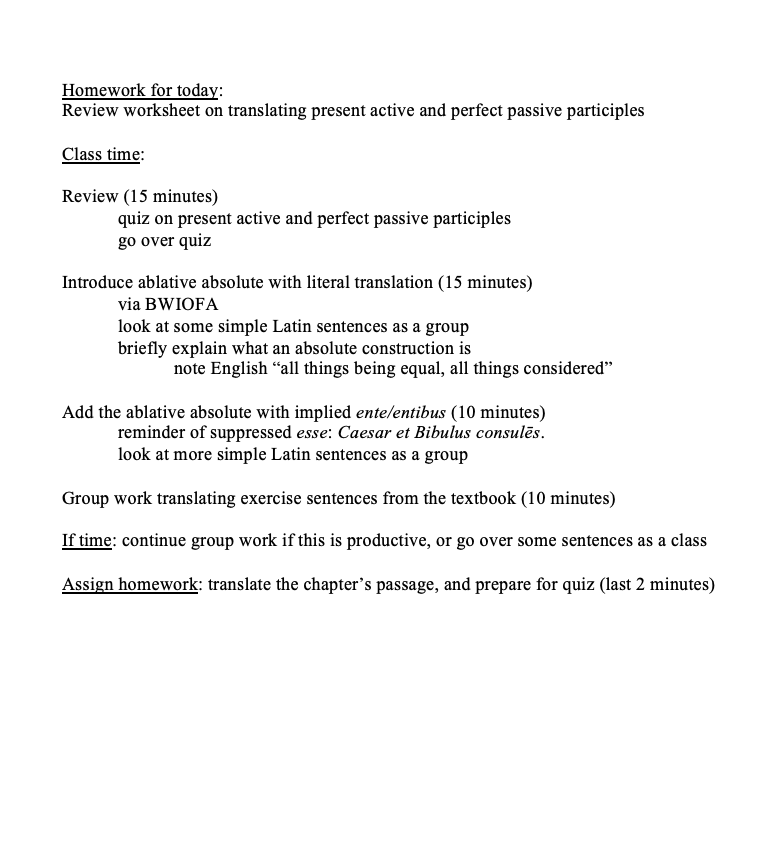
If things go poorly, which happens, I can postpone the passage and assign more exercises from the book for homework instead. An ideal lesson plan is one that gives you both direction and flexibility in case things don’t work out as you hoped. You can’t control every aspect of class, and it takes time to learn how to pivot on the spot when you need to. But the lesson plan keeps you focused so that, if things go awry, you always have a reminder of where you’re trying to go.

