Kirsten Traudt
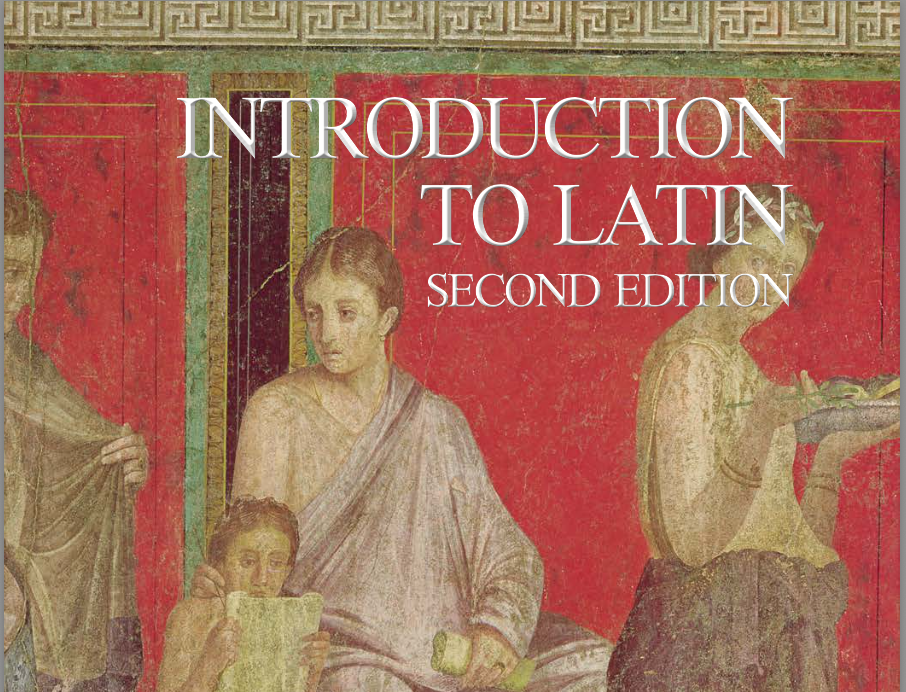
Susan C. Shelmerdine’s Introduction to Latin: Second Edition provides a (mostly) full introduction to Latin which is aimed at students with little or no previous background in the language. Although it’s a “grammar-translation” style textbook, it also includes short readings adapted from Classical poetry and prose. Readings in the early chapters primarily discuss the Trojan War myth and the founding of Rome, while later chapters include a wider range of subject matter.
One strength of the textbook is that it introduces grammar in roughly the same order as Wheelock’s Latin does, so supplementary readings and exercises designed for use with Wheelock can also be used (occasionally with small modifications) with Shelmerdine. Each of Introduction to Latin’s thirty-two chapters also include a range of exercises which can be used in class or assigned as homework, while the book’s extensive appendix provides helpful paradigms and vocabulary lists organized alphabetically and by chapter. The chapter-by-chapter vocabulary lists are especially useful for instructors seeking to develop exams or exercise sentences, since they offer an easy way to check whether a word has already been introduced. The Repositorium (an access restricted repository of teaching material in the Classics Department at Yale) includes several stories and supplementary exercises designed to be used with Introduction to Latin, so instructors are encouraged to explore these when planning lessons.
The following blog post will discuss developing a schedule that works for Introduction to Latin, using the exercises provided in the textbook, working with the set readings, and supplementing the book with other resources. Arguably, the book’s biggest downside is the frequent mismatch in difficulty between the chapter exercises and the chapter readings, so some suggestions will be provided for navigating this difficulty without creating more work for the instructor.
It is important to note that there is an answer key available online, which students will likely use even if you tell them not to. With this in mind, instructors may find it helpful to assess comprehension of homework exercises via closed-book assessments or in-class activities, rather than asking students to hand in exercises that they may or may not have completed with the help of unauthorized resources.
Scheduling
Introduction to Latin is split into thirty-two short chapters, which contain grammar explanations, exercises, at least one short reading, and a vocabulary list. Almost every chapter can be covered in three fifty-minute class periods, so it is helpful to plan across three-day blocks, with some additional days built in for exam prep and review of difficult contexts.
Most chapters introduce 2-3 new morphological or syntactical concepts which can be covered over the course of two days of introduction and practice. The third day of the unit can be used to complete a short reading (see below) or an alternative activity, such as a composition exercise. Although vocabulary lists are printed at the end of the chapter, it is useful to do vocabulary quizzes as the beginning of a unit, since Shelmerdine uses the chapter vocabulary in the exercise sentences. For an example of how a chapter might be covered over the course of three days, see the chart below, which shows how Chapter 12 can be split up:
| Framework | Lesson Content | Homework | |
| Day 1 | Vocabulary Quiz + Concept 1 | Chapter 12 vocabulary quiz, introduction to and practice with adverbial dependent clauses. | Exercises 89-91 (selections) |
| Day 2 | Concept 1 Review + Concept 2 | Assessment of Day 1 homework/review of adverbial dependent clauses, introduction to and practice with accusative of extent/degree and datives with adjectives. | Exercises 94-95 (selections), preparation of Reading 15 |
| Day 3 | Concept 2 Review + Reading | Assessment of Day 2 homework/review of accusative and dative case uses, Reading 15. | Read Chapter 13 and prepare for a quiz on Chapter 13 vocabulary. |
By following this structure, you should reach Chapter 18 (relative clauses/interrogative pronouns) by the end of one semester (13 weeks) and complete the textbook by the eighth week of the second semester.
This provides ample time to read a short unadapted text at the end of the second semester. The book’s vocabulary lists cover a range of high-frequency words, so students should be well-prepared to read a range of texts with some additional vocabulary help. It can be rewarding to choose a text that aligns with the interests of an individual class, but previous L2 instructors at Yale have had success with reading:
- Selections from Cicero’s speeches (In Catilinam 1 is a good choice and can be read nearly in full, but other instructors have read the Pro Marcello)
- Selections from Caesar’s De Bello Gallico
- Selections from Pliny the Younger’s Letters
- Selections from Seneca the Younger’s Letters
- Selections from Hyginus’ Fabulae
In addition, selected short poems from authors like Catullus and Martial would be appropriate for students who have completed Introduction to Latin if you provide additional vocabulary help.
Using Shelmerdine’s Grammar Explanations and Exercises
Students who have used Introduction to Latin appreciate its compact, streamlined morphological tables, which are supplemented by an extensive grammatical appendix at the back of the book. However, Shelmerdine’s streamlined approach mans that some of her grammatical explanations are sparse. You should expect to devote class time to both elaborating upon the textbook explanations of grammar concepts and working through drills and practice exercises. If you would like to follow a “flipped classroom” model in your class, you would likely need to find or create additional resources to help prepare students for a class which included less explicit grammar instruction. Introduction to Latin is also relatively jargon-free, so you should also be aware of points where students might find it helpful to learn alternative names for the same concepts (e.g. “purpose”/“final” clauses).
Although the Latin-English and English-Latin exercise sentences are cumulative, many exercises test single concepts, especially in the early chapters. This makes them easy to incorporate into the three-day plan described above. Some exercises are especially helpful for in-class assessment; for example, you may wish to have students complete parsing or morphology exercises in pairs to test their knowledge of new word forms. Other exercises, such as the chapter sentences, can be set as homework. You may even wish to assign some of the “Practice Sentences” at the end of each chapter, which are adapted sentences of Classical Latin, rather than exercises wholly derived by Shelmerdine herself. However, don’t feel like you have to assign every exercise; you should encourage students to use textbook exercises not covered in class as additional practice and might find it helpful yourself to draw upon them when creating review materials.
Additionally, you can use the framework of the textbook sentences to create custom exercises for your class. If you find that your class is struggling with a certain vocabulary term or concept, you might want to add it to later exercise sentences to provide additional review. Alternatively, you can use the provided sentences in a different format to create exercises that you feel better serve your pedagogical goals. The textbook is a resource for your students, but it can also help you lessen the load of deriving novel exercises by giving you a framework to build upon.
Readings
One of Introduction to Latin’s most distinctive features are its end-of-chapter readings, which are increasingly lightly modified passages of Classical prose and poetry from a variety of authors. Early readings focus on the Trojan War and the legendary history of Rome, but as the book progresses, they vary more in content and genre. Readings seem to be chosen as exemplars of the grammatical concepts discussed in each chapter, but that is not always the case, and some readings are not helpful assessments of the grammar concepts discussed. Additionally, many readings include vocabulary and grammar concepts which are unfamiliar to students. Although Shelmerdine provides extensive glosses, this can create a frustrating reading experience, especially after the first few chapters, whose readings are much simpler.
Consequently, you should not always assume that every end-of-chapter reading will be the most helpful or appropriately challenging content for students. When working with Introduction to Latin, it is important to carefully read and evaluate every reading to ensure it will be a productive exercise for your students. Some chapters have multiple readings, so you may choose the one that is more interesting and/or appropriate. If the provided readings do not seem interesting or appropriate, you may wish to choose from one of the readings available on the Repositorium or create/adapt your own readings for use in class. Sometimes, it might be appropriate to do a chapter reader slightly later than Shelmerdine intended; by holding off on some readings until students have had more practice, they might be able to approach the existing materials with more confidence.
In addition, it’s your job as the instructor to introduce and contextualize each reading. Shelmerdine includes readings adapted from famous authors like Livy, Caesar, Cicero, Vergil, Pliny, and Tacitus, but many of the chapter readings also come from lesser-known writers like Cornelius Nepos or Florus. Since you can’t assume that your students will be familiar with any Roman authors or Roman history, you should build in time during your lessons to introduce each author and text before teaching it. An advantage of working with adapted Classical Latin is that many of the readings provide a chance to talk about important topics in Roman history and culture, so it’s a good idea to be prepared to provide additional context for the passages students are reading. This is especially important because some texts, such as the Chapter 13 reading about the assault of Lucretia, deal with sensitive topics without additional scaffolding. While it doesn’t serve anyone to ignore violent or discriminatory elements of Roman culture, discussing this content sensitively creates a better classroom experience for all students.
Additionally, because of the focus on literary texts, the textbook provides relatively few examples of documentary or non-elite writing. Instructors may wish to supplement the textbook readings with inscriptions or graffiti which provide a fuller view of how Latin was written. A useful resource is By Roman Hands: Inscriptions and Graffiti for Students of Latin by Matthew Hartnett (Hackett, 2012), which provides a selection of inscriptions edited for introductory students and organized by grammar topic.
Supplementing Shelmerdine
In addition to materials created for individual class sessions, instructors may find it helpful to begin introducing students to more traditional Latin grammar books at the L2 level. Because Shelmerdine focuses on the essentials of grammar or syntax, some concepts are treated in a very cursory way (such as relative clauses of purpose and result) or omitted entirely (such as quin or quominus clauses, or conditionals in indirect statement). This clarity is initially an advantage for students, but they may struggle in subsequent semesters if they aren’t shown where to find more detailed information.
In addition, showing students how different dictionaries present vocabulary can be helpful. Shelmerdine presents the fourth principal part with the masculine singular (-us) ending and uses the future active participle as the fourth principal part in the case of intransitive verbs. Because this is not the case with all dictionaries, it is useful for the instructor to explain Shelmerdine’s choices in order to avoid future confusion. If students are struggling with using Introduction to Latin, being exposed to other resources may also help them find an approach that resonates more with them and benefits their future language learning.
 Classics Teaching