Learning vocabulary isn’t simply a matter of learning what roots mean. However, many or most of your students will assume it is. You need to be sure they know that vocabulary is both lexical and morphological.
Take amō, amāre, amāvī, amātus. This string of words does not mean “I love.” Only amō means that, and in the case of amō, the am(ā)– means “love” and the –ō means “I” presently and actively and indicativally. So already we’re getting morphological.
You cannot expect students to know that vocabulary is morphological, as well as (if not more so than) lexical. Realistically, you can’t expect them to know what morphology is in the first place or what relevance it has to learning a language.
You will see both of the following:
(1) Students who think simply learning the meaning of roots is what matters. These students tend to think that if they just learn what words mean lexically they can translate successfully. To respond to and help students of this category, see The Flow <forthcoming>.
(2) Students who just don’t learn the vocabulary, lexically or morphologically. Why? One reason is that learning vocabulary is tedious. You look up the same words over and over again, giving you the sense you aren’t ever improving. Long story short, it’s not fun. For this reason, you must quiz them on it regularly. Have weekly vocab lists and quizzes as a constant throughout your course, no matter the level.
It’s hard to learn how to learn vocabulary. Here is a handout I wrote for students on some best practices:
As for testing vocabulary, you have options. Here are some.
I like to begin the second half of an introductory course, when we are still working through a textbook, with basic recognition quizzes that ask students to review previous vocabulary lists. Here’s an example of an asynchronous vocab recognition quiz:
But what about the “vocab is also morphology” line? This quiz isn’t intended to test that. It is meant simply to refresh our memory of some core vocabulary we learned in the first half of the textbook and probably forgot over break. Real vocabulary quizzes come later.
The standard vocabulary quiz I use is a bit lazy and predictable. Effectively it reproduces part of the vocab list in the book and asks the student to fill in the blanks. But it works:
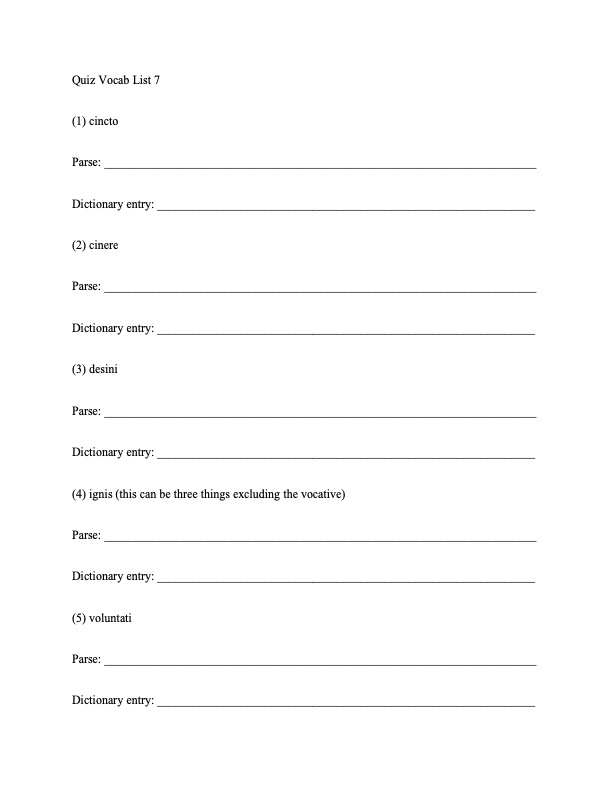
Another type of vocab quiz gives inflected forms of words and asks students both to parse and to provide dictionary entries. These test memory not only of lists but also of paradigms (more morphology the better!) and are no doubt best for a course or program with high expectations:
We at Classics Teaching would love to see other ways of testing vocab!
 Classics Teaching