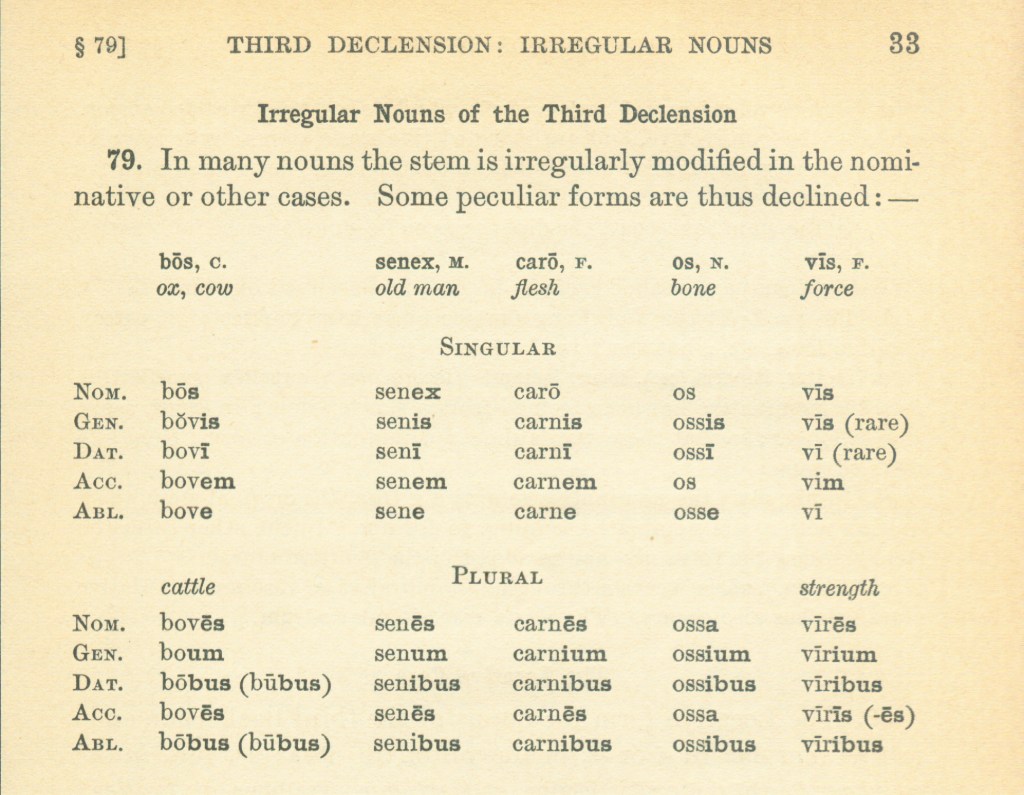
The grammar-translation method is the most traditional of the various different approaches to classics pedagogy. Two well-known textbooks that employ the grammar-translation method are Hansen and Quinn’s Greek: An Intensive Course (1978) and Wheelock’s Latin (1956). In courses taught using this methodology, students learn grammar deductively and practice grammatical rules by doing drills and translating sentences from Latin and Greek into the target language.
One of the foremost advantages of the grammar-translation approach is that it allows teachers to introduce an entire paradigm all at once and test students on it by having them complete drills and exercise sentences. For example, to teach the dative, a teacher using a grammar-translation approach might explain the various different uses of the dative case and present its full declension before having students translate a sample sentence. The reading method, by contrast, typically requires teachers to introduce any given paradigm across multiple chapters (for example, students in reading-based class may only learn one case of a declension at a time).
One potential drawback of this method is that students may feel overwhelmed by rote memorization without the reward of reading stories. Moreover, the grammar-translation approach sometimes yields students who are proficient at producing charts, but not necessarily at reading. Lastly, the practice sentences in textbooks that use such an approach are often not representative of the prose-style or content of ancient Greek and Latin texts (though the same is true of reading-approach textbooks such as Oxford Latin or the Cambridge Latin Course).
Further Reading
For discussion of implementation of the grammar-translation method at the high-school level, see Singh (1998). May (1998) treats the grammar-translation method at the university level. Bastone and Ellis (2009) discusses the cognitive theory underpinning the teaching of grammar in general. Mahoney (2004) identifies which morphological forms are most salient for students of Greek and Latin. Ramsby (2020) contextualizes use of the grammar-translation method in recent years in relation to various other approaches. Swann (2002) assesses the method’s strengths and weaknesses.
-Batstone, R. and R. Ellis (2009). “Principled Grammar Teaching.” System 37: 194-204.
-Mahoney, Anne. (2004). “The Forms You ‘Really’ Need to Know.” The Classical Outlook 81.3:: 101-105.
-May, J. (1998). “The Grammar-Translation Approach to College Latin.” In Latin for the 21st Century: From Concept to Classroom, 148-61.. Glenview, IL: Scott Foresman-Addison Wesley.
-Rambsy, T. (2020). “Changing Methods in Latin Teaching. Highlights of a Survey.” The Classical Outlook 95.1, 20-27.
-Singh, K. (1998). “Grammar-Translation and High-School Latin.” In Latin for the 21st Century: From Concept to Classroom, 90-104. Glenview, IL: Scot Foresman-Addison Wesley.
Image credit: Meagan Ayer, Allen and Greenough’s New Latin Grammar for Schools and Colleges. Carlisle, Pennsylvania: Dickinson College Commentaries, 2014: 33.
—Talia Boylan
 Classics Teaching